

The Forum is a large London-based venue, a place that many bands dream of selling out but something which only a handful are capable of achieving. This old theatre has been the home of the Swedish Melodic Death Metal band Amon Amarth for many years now and it was in the backstage area of said establishment that I met bassist Ted Lundström for a short but thoroughly enjoyable interview.
Looking clearly excited about the prospect of performing another sold out headlining gig in the UK, the softly spoken musician spoke with affection about the band’s latest brainchild “Deceiver Of The Gods”, the band’s upcoming US tour and also indulged with me with a discussion of a purely cultural/anthropological nature.
By Yiannis (John) Stefanis.
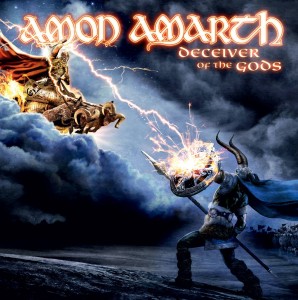
Ted: Actually, yes. We haven’t tried all of the songs yet, to be honest, but we have played most of them live and they are working really well – especially the ones released first, such as “Deceived Of The Gods”. This is a great song to perform live as people tend to sing along to the main melody in a way that’s similar to songs written by bands like Iron Maiden.
So far on this tour we’ve been trying stuff, swapping a couple of songs each night in order to see which ones work best. We did Mayhem Festival in the US but, at this stage, the album was not out yet so we only performed one song there. Now that we are doing a European tour we are working on finding which songs work best in a live setting. So far, everything that we play live from the new album has been received very well by the audience.
Ted: That is indeed a big problem because you want to squeeze into the set as many songs as you possibly can in order to please the fans of the old material as well as those of the new while, at the same time, you are trying to promote your new album.
It’s really tough, that’s why we are changing our set list a little bit each time – in order to find what works best. Some songs work really well in England while others work better in Germany, for instance.
You never know, and it doesn’t matter how long your set will be as there are always going to be some fans who will feel disappointed for not getting to listen to their favourite song. It takes a while to create a set list because it needs to have a good flow and a mixture of different styles of music – its hard work but a nice problem to have (laughs).
Ted: Well, once you’re in the studio and you start recording, everything is more or less already done. Back in the day we would write a riff and we would be too worried whether something “sounds too much like this and that” and we would be very picky as per what could be added or not. In the end it is only us who get to worry about these things so we decided, in this case, to let everything in and do exactly what we wanted.
The same thing happens in the studio. The last couple of years we had to record everything in small pieces as everything had to sound perfect with the new digital recording systems so we decided to work differently this time round. Of course you want things to sound perfect, but we took longer takes of everything so as to infuse the album with an old-school feel as back in the old days you had to play a whole song in one take.
We tried to give that feel to “Deceiver Of The Gods” and it was quite fun recording it as we went to a new studio and we worked with Andy Sneap who is an amazing producer and a much talented really cool guy. It was fun – I really enjoyed recording this album.
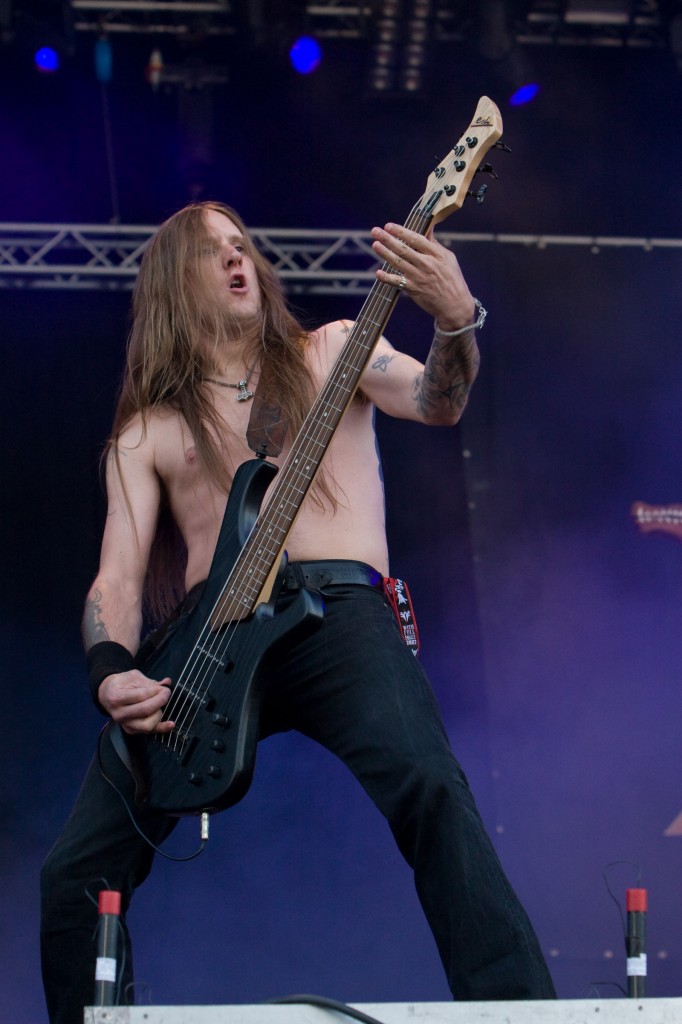
Ted: I am not worried about losing the Amon Amarth sound because it’s nothing specific that we do in order to create that sound in the first place. Whatever it is that we do ends up sounding like this – it’s a natural process. Sometimes we do…I remember when we wrote “Father Of The Wolf” we were like “this is so much old-school Heavy Metal and it will not end up sounding like us at all” but still, once the whole production process was finished and the vocals were added, what we found out was that it did sound like us after all. I believe that we can try to do anything we want and you will still be able to detect that it is our product.
Ted: No, not at all. Everybody seems to be quite pleased with our new material. We have been fortunate enough to have a record label (note: Metal Blade) that would never push us in any direction. They trust us and thy let us do whatever it is that we want to do. They would never say things like “This is not good enough” or “You should do this, you should do that” in order to please others. We never had that problem.
Ted: These are bands whose music we have been listening to for a long time and feature in their ranks people that we know from before this tour was put together so things are pretty relaxed and laid back. There are no problems whatsoever – everything rolls over like a well-oiled machine. We are really happy with the line up for this tour; it’s been great so far and hopefully things will become more enjoyable as the days go by.
Ted: Well… (laughs) not really but, of course, that is the whole point with putting together packages like this one – to convert fans that are loyal to the other bands. That’s the ultimate goal. We do have a very interesting mix of bands on this tour: this theatrical Heavy Metal thing with Hell, the classic Death Metal thing with Carcass and then us performing our own stuff that’s a bit more melodic.
Also tonight you will see on stage Bleed From Within who perform more modern stuff so we’ve got a little bit of everything here for you. Hopefully we will be able to steal some fans from all those bands as I am sure they are looking forward to stealing some of ours in the process.
Ted: The Metal fans that we managed to win over in America are pretty much the same like those you find in Europe but the US in general is a bit more superficial as, sometimes, image is the most important thing.
I don’t think that we really had any problems with that as we always did our thing and our record labels in the US always took care of everything that needs to be done for us. All we can do is to write music and tour as much as we can – whether that works or not is, in a sense, out of our hands. It doesn’t really matter anyway as we are not going to change in order to fit into the US market anyway. They should either accept us as we are or not.
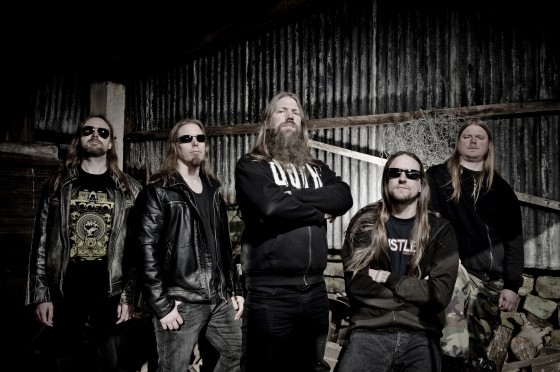
Ted: Well, it is what it is and really there isn’t such a massive difference between touring there and touring in Europe where you sometimes find yourself criss-crossing the continent in order to play as many venues as you possibly can. It’s just…it’s pretty much the same: you play a show, you get on the bus, you sleep and when you wake up you are in a totally different place.
This is what we do – we make an album, we tour for two years and then we start working on a new album so for me it doesn’t really matter how we do it. If we go to South America to fly between shows it is sometimes even harder because you have to spend so much time at airports being early enough to check in all your equipment and go through security. Then the whole flying thing and, in some places, the customs and immigration procedures are quite time consuming. Touring is usually a long pain in the ass no matter where you go, but once you’re on stage you forget all about that because this is what you live for.
Ted: Well, for us things are not too tricky because we are an easy going band. There is no tension between the members which is something that many other bands get to experience, especially when they have been through various member changes.
We, on the other hand, have had the same line up for a long time and so we know each other very well. When we are on tour spending time in the same confined space is not a massive problem for us – the travelling and all that sh*t, all the boring stuff that comes along with touring…well, it is what it is and it’s still much better than waking up and having to go to a boring 9-5 job at home – it beats that every day of the week anyway. Sometimes you forget that but then you have to tell that to yourself when you’re on tour. It is when you start to think that everything sucks that you have to remind yourself that this is a much better job than the one you did before and that makes things much easier.
Ted: Well, we always try to stay true to what we do regardless of trends. When this ‘Pagan wave’ arrived a couple of years back we made a conscious effort to stay a little bit outside that rather than jumping onto the band wagon in order to grab a few new fans in the process. The important thing is to do your stuff 100% and not really care what’s going on around it. Our Viking image has been very important for the band but, for us, the main focus has always been the music itself. I have no secret recipe to give away to you with regards our longevity but things have been really working for us.
Ted: Yeah, for sure.
Ted: In the beginning it was king of weird as you would ended up seeing such things everywhere you went but I do believe that it is a cool thing and not that strange if you think of it. Other people’s stories and tales are always interesting to you. I find stories about Ancient Egypt to be absolutely fascinating and the same applies to stories from Ancient Greece.
In Asia you also have many interesting civilizations to draw such stories from and it is always fun to take in something new that you normally cannot find in your own culture. The more you learn something new the more you want to read about it. We meet a lot of new people every time we go on tour and they are normally like “I never knew about this story before and, since I listened to your song, I have read everything I could find in relation to it” which I think is cool – having people searching for things to read in relation to northern mythology. It’s cool and these are great stories for us to use and refer to in our lyrics and album concepts in general.
Ted: Exactly! Sometimes, especially when we play in the southern parts of the US and in areas inhabited by Indian tribes, we do find that there is a strong connection between us and these people as their religion and culture is nature-based – exactly as ours was before Christianity was introduced. Things work over there in the US the same way as they do in Europe in that respect; there is a form of connection as a result of similarities between our past cultures.
Ted: Basically we always take things one step at the time and try not to look to far ahead. People often ask us in interviews things like “When you first formed the band did you ever dream of reaching this far” to which the answer is “No”. You set one goal at a time and when you reach it you know that it is time to set the next one. The first goal was getting a record deal, which we of course did, and since then we aim at one goal at a time. It is a case of ‘one step and the time and see where that gets us’. Of course, there is a limit as to how far you can go as a Death Metal band but I do believe that there is still room to grow.
Ted: Thank you very much.


